EUDR for Furniture Importers: What You Need Before 30 December 2026
CasaViva Furniture · 19 September 2026

There is no such thing as an EUDR certificate. No authority issues one, no laboratory tests for it, and a supplier offering you an "EUDR certified" document is offering something with no legal standing. What the law requires is a due diligence statement that you, the importer, file under your own name — and most of the data in it has to come from your factory.
Last verified: 13 September 2026, against Regulation (EU) 2023/1115 as amended by Regulation (EU) 2025/2650, Commission Implementing Regulation (EU) 2025/1093, and the Commission's product scope announcement of 13 July 2026. Every article number below was checked against the text on EUR-Lex, not against secondary summaries.
Published by: CasaViva Furniture · This is a sourced explainer written from a supplier's side of the table. Images are illustrative. It is not legal advice, and tariff classification of a specific product should be confirmed with your customs broker or through a Binding Tariff Information decision.
The short version
30 December 2026 for medium and large operators; 30 June 2027 for micro and small ones — but the small-company extension does not cover most wooden furniture (why).
Scope turns on whether the item is wooden. Annex I covers ex 9401 seats "of wood" and wooden furniture under 9403. Metal and plastic furniture is not listed.
If you import directly from outside the EU, you are the operator. If a seller outside the EU places the goods on the EU market itself, Article 7 makes the first EU company that makes them available a deemed operator.
Risk classification follows the country where the wood grew, not where the furniture was made. China is low risk; Brazil, Indonesia and Malaysia are standard risk. Plywood made from Indonesian timber in a Chinese wardrobe is a standard-risk input in a low-risk factory.
Member States must set the maximum fine at no less than 4% of EU-wide annual turnover, plus confiscation of goods and revenues. The Commission publishes the names of companies with final judgments against them.
On this page
Who this is for
EU-established importers, wholesalers and retail chains buying finished wooden furniture from outside the EU, and the sourcing teams who have to get the paperwork out of the factory.
Not for: operators dealing only in cattle, cocoa, coffee, oil palm, rubber or soy; or ranges that are entirely metal and plastic, which are not in Annex I.
Is there an EUDR certificate?
No. The EUDR runs on self-declaration, not approval. You collect the information, assess and mitigate the risk, and submit a due diligence statement into the EU information system under your own company's name before the goods go on the market. There is no notified body, no accreditation, no test report, and nobody to apply to.
What replaces the certificate
Article 4(2) requires the operator to submit a due diligence statement before placing the product on the market. Annex II lists its contents: your name, address and EORI number; the HS code, free-text description, trade name, full scientific name where applicable, and quantity; the country of production and the geolocation of all plots of land; the prescribed declaration that due diligence was carried out and no or only negligible risk was found; and a signature.
Why "EUDR certified" on a supplier profile is a warning sign
A factory advertising EUDR certification either misunderstands the regulation or is relying on you to misunderstand it. Ask instead whether they can deliver the eight items in Article 9(1), and how many working days it takes them.
Is your furniture in scope?
It depends on whether the item is wooden. Annex I does not cover "furniture" as a category. It lists specific Harmonised System codes, and for seating it uses a qualifier rather than a list.
The test, in the Annex's own words
For seating, Annex I reads: ex 9401 — Seats (other than those of heading 9402), whether or not convertible into beds, and parts thereof, of wood. The "ex" prefix and the words "of wood" decide the scope.
It is not limited to the wooden-frame sofa subheadings; it reaches every part of heading 9401 whose description is "of wood", which includes wooden swivel chairs, wooden sofa beds and wooden parts as well as wooden-frame upholstered seating. The Commission's July 2026 scope update removed aircraft and motor vehicle seats, which is consistent with heading 9401 otherwise reaching them.
For non-seating furniture, Annex I is an explicit list: 9403 30, 9403 40, 9403 50, 9403 60 and 9403 91 — wooden furniture for offices, kitchens and bedrooms, other wooden furniture, and wooden parts.
ItemIn Annex I?Basis Seating of wood — upholstered or not, fixed or convertibleYesex 9401 … of wood Seating on metal framesNoNot "of wood"; classifies outside the ex carve-out Wooden office, kitchen, bedroom and other furniture; wooden partsYes9403 30 / 40 / 50 / 60 / 91 Metal furnitureNoNot listed in Annex I Plastic furnitureNoNot listed in Annex I Wooden articles of furniture not falling in Chapter 94Yes4420, which is separately listed Particle board and OSB / fibreboard / plywood and veneered panelsYes, in their own right4410 / 4411 / 4412 Wooden packing cases, crates, palletsYes — except when used exclusively as packing to support, protect or carry another product placed on the market4415, with the parenthesis in Annex I
This table is a reading guide, not a classification ruling. Where an item sits near a boundary — a rattan chair with a wooden frame, a wardrobe with a metal carcass and wooden doors — get the classification confirmed before you plan around it.
Why the frame material decides so much
Two armchairs that look identical to a customer sit on opposite sides of Annex I if one has a wooden frame and the other a steel one. That has a practical consequence during a programme: a specification change to the frame changes your obligations, in either direction, and it is the kind of change a factory may treat as a cost engineering decision rather than a regulatory one. Put frame material on the change-control list.

Illustrative image. A wooden frame and a steel frame of similar design sit on opposite sides of Annex I: seating of wood is listed, seating on metal frames is not.
Boards pull the obligation upstream
Particle board (4410), fibreboard (4411) and plywood (4412) are listed in Annex I as products in their own right. A flat-pack wardrobe is declared once, under 9403 50. But because the boards it is made from are themselves relevant products, the information you owe under Article 9 runs back past the furniture factory to the mill and beyond it to the forest. Traceability has to survive a blending step to get there, which is the structural problem set out below.
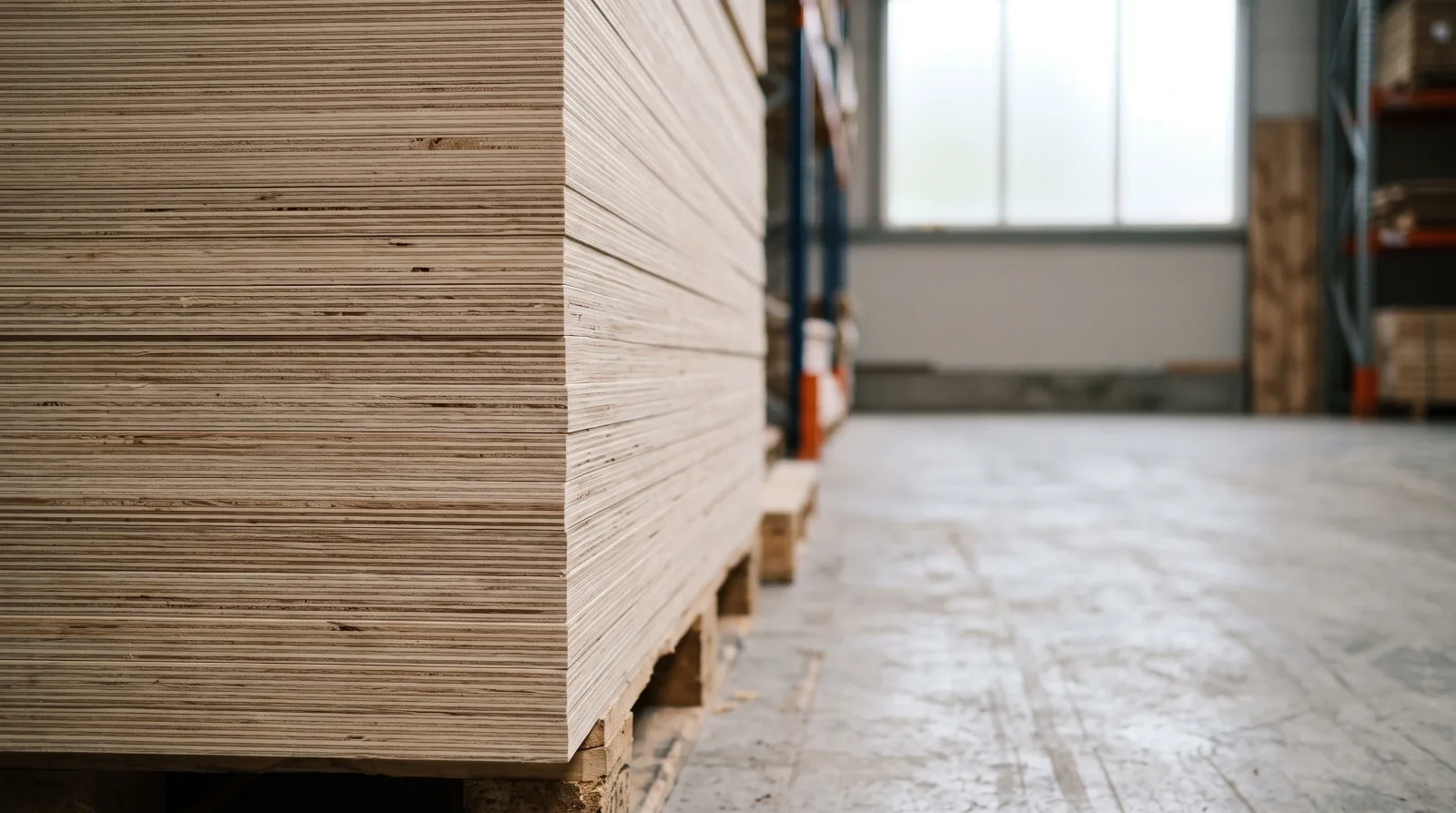
Illustrative image. Plywood (4412) is listed in Annex I in its own right, as are fibreboard (4411) and particle board (4410).
Pallets and crates
Annex I lists 4415 but adds a parenthesis excluding packing material "used exclusively as packing material to support, protect or carry another product placed on the market". The pine pallet under your container of sofas falls in that exclusion; a pallet imported to be sold as a pallet does not. As of 13 July 2026 the Commission has also adopted horizontal exemptions covering packing material, which are in scrutiny — check the final text rather than relying on the parenthesis alone.
Bamboo and rattan
Wood is the relevant commodity; bamboo is not one of the seven. Annex I already excludes bamboo-based products from the pulp and paper entry, and the Commission's July 2026 delegated act extends the "ex" prefix to further entries specifically so that products made with non-relevant commodities such as coconut oil and bamboo are not captured. Rattan and bamboo seating classify separately from wooden seating. Confirm the classification of a specific model before treating it as out of scope.
When does it apply, and has it moved again?
30 December 2026 for medium and large operators, and for micro and small operators handling products already covered by the EU Timber Regulation; 30 June 2027 for other micro and small operators. The date has moved twice: the original text set 30 December 2024. Regulation (EU) 2024/3234 pushed it twelve months. Regulation (EU) 2025/2650, published in the Official Journal on 23 December 2025, pushed it twelve months again.
InstrumentMedium and largeMicro and small Reg. (EU) 2023/1115, original Art. 3830 December 202430 June 2025 Reg. (EU) 2024/323430 December 202530 June 2026 Reg. (EU) 2025/2650 — in force30 December 202630 June 2027
The small-company extension does not cover most wooden furniture
Article 38(3), as replaced by Regulation (EU) 2025/2650, grants the later date to micro and small undertakings. It opens with a carve-out: "Except as regards the products covered by the Annex to Regulation (EU) No 995/2010".
That Annex belongs to the old EU Timber Regulation, and it listed wooden furniture — 9403 30, 9403 40, 9403 50 00, 9403 60 and 9403 90 30. It did not list 9401 seats.
So a small EU importer with a mixed catalogue has two dates:
Wooden beds, wardrobes, kitchen and office furniture under 9403 30/40/50/60, and wooden furniture parts under 9403 91 (listed in the old Annex under the pre-2022 code 9403 90 30; confirm the classification of specific parts with your customs broker) — 30 December 2026. No extension.
Wooden seating under 9401 — 30 June 2027.
There is a second condition. The extension applies only to operators that were established as micro or small undertakings by 31 December 2024. A company incorporated in 2025 does not get it at all.
Warning: Small EU importers: wooden beds, wardrobes and other 9403 furniture stay on 30 December 2026. Only wooden seating under 9401 moves to 30 June 2027.
The Commission states the same split in plain language: the Regulation applies "from 30 December 2026 for large and medium-sized operators and for micro and small operators already covered by the EU Timber Regulation, and from 30 June 2027 for other micro and small operators".
The July 2026 scope update
On 13 July 2026 the Commission adopted a delegated act updating Annex I. It removes cattle hides, skins and leather, re-treaded tyres, soybeans for sowing, articles of vulcanised rubber, conveyor and transmission belts, and aircraft and motor vehicle seats.
It adds soluble coffee, certain palm oil derivatives and frozen cattle tongues, which become subject to the Regulation from 30 December 2027. The Commission notes the update "does not alter the list of commodities covered by the regulation, but concerns products derived from those commodities" — wooden furniture entries were not amended.
Two parts of the same act matter to a furniture shipment. It clarifies that samples and products used for analysis, examination and testing are outside scope, and it introduces targeted exemptions for categories including waste, used and second-hand products, and packing material. The act was sent to the Parliament and Council for scrutiny before entry into force, so confirm the final text in the Official Journal before relying on any of it.
Who is the operator — and why it is probably you
If you import furniture directly from outside the EU, you are the operator. The legal route to that answer runs through the definitions of operator and downstream operator; Article 7 covers the case where a seller outside the EU places the goods on the market itself.
An operator is any person who, in the course of a commercial activity, places relevant products on the market or exports them. Regulation (EU) 2025/2650 amended that definition to exclude a new category, the downstream operator. Article 2(15b) defines it as a person who places on the market or exports relevant products "made using relevant products, all of which are covered by a due diligence statement or by a simplified declaration". One partly-uncovered input and the status does not apply.
The condition is what decides it. Goods bought directly from a factory outside the EU normally arrive without any EU due diligence statement or simplified declaration, so the first person placing them on the EU market is a full operator.
How you buyYour roleWhat you must do Direct import from a factory outside the EUOperatorDue diligence under Art. 8–11, submit a DDS under Art. 4(2), keep Art. 9 records five years Buy finished goods from an EU wholesaler and resell them unchangedTraderArt. 5(3): collect supplier and customer identification and, only where the supplier is an operator, the DDS reference numbers or simplified-declaration identifiers; keep five years Buy relevant products already covered by a DDS and use them to make something you then place on the marketDownstream operatorSame Art. 5(3) obligations as a trader; no DDS of your own Either of the above, where you are not an SMENon-SME trader / non-SME downstream operatorThe above, plus registration in the information system before placing on the market (Art. 5(2))
The SME test in the last row is applied to you, not to your supplier.
What downstream operators and traders still have to do
Article 5, as replaced, is titled "Obligations of downstream operators and traders". They do not submit due diligence statements. Under Article 5(3) they must collect the name, registered trade name or trade mark, postal address, email and, if available, web address of both their suppliers and their customers, plus, only where the supplier is an operator, the DDS reference numbers or simplified-declaration identifiers, and under Article 5(4) keep it at least five years.
Article 5(5) requires immediate notification of the competent authority on learning of a risk of non-compliance. And the exemption from verifying due diligence is not absolute: under Article 5(6), a non-SME downstream operator or non-SME trader facing a substantiated concern must verify that due diligence was exercised, and may place the product on the market only if the risk is negligible.
What must your supplier hand over?
Article 9(1) lists eight items. Your factory has to produce most of them.
Art. 9(1)What the law requiresWhat that means on the factory floor (a)Description, trade name and type; for wood products, the common name and full scientific name of the species; plus the list of relevant commodities contained in the product"Hardwood" is not an answer. The BOM has to say Hevea brasiliensis. Every wooden component is listed separately. (b)Quantity, in kilograms net mass and, where applicable, the supplementary unit against the HS codePacking list data, aligned to HS subheadings rather than to your SKU list. (c)Country of production and, where relevant, parts of itWhere the trees grew, not where the factory is. This field also decides your risk classification — see below. (d)Geolocation of all plots of land where the commodities were produced, plus the date or time range of productionThe hard one. See below. (e)Name, postal address and email of any business or person from whom the operator was supplied with the relevant productsRead literally, this is your direct supplier. Tier-two identities become necessary through (d), (g) and (h), not through (e) — but you will still need them. (f)Name, postal address and email of any business, downstream operator or trader suppliedYour side of the chain. (g)Adequately conclusive and verifiable information that the products are deforestation-freeVerifiable evidence tied to each plot and to the 31 December 2020 cut-off — a general statement is not enough. (h)Adequately conclusive and verifiable information of compliance with the law of the country of production, including any arrangement conferring the right to use the areaForest tenure and harvesting documentation from the country of harvest.
Retention: five years from the date of placing on the market or export, per the opening sentence of Article 9(1).
How precise does geolocation have to be?
Article 2(28) defines it: latitude and longitude, at least one point, with at least six decimal places. For plots larger than four hectares producing commodities other than cattle, a single point is not enough — a polygon with enough points to describe the perimeter of each plot is required.

Illustrative image. Article 9(1)(d) asks for the geolocation of every plot of land the wood came from, not just the country.
The clause with no mitigation step
Article 9(1)(d) also provides that any deforestation or forest degradation on a given plot "shall automatically disqualify all relevant commodities and relevant products from those plots of land from being placed or made available on the market or exported". There is no risk-weighing step and no mitigation option attached to it.
China is low risk. Which of your products is not?
The regulation defines two different countries, and the difference decides this question. Article 2(23) defines "country of origin" by reference to the customs rules in Article 60 of Regulation (EU) No 952/2013. Article 2(24) defines "country of production" as "the country or territory where the relevant commodity or the relevant commodity used in the production of, or contained in, a relevant product was produced".
A sofa assembled in Guangdong has country of origin China. Its country of production is wherever the tree grew. Risk classification runs on the second of those: Article 16(8) sets the standard-risk check rate for products "made using relevant commodities produced in a country of production or parts thereof classified as standard risk", and Articles 16(9) and 16(10) do the same for high and low risk.
Commission Implementing Regulation (EU) 2025/1093 of 22 May 2025 puts China on the low-risk list, together with Vietnam, Thailand and Papua New Guinea among others. Four countries are high risk: Belarus, the Democratic People's Republic of Korea, Myanmar and the Russian Federation.
The countries that are on neither list
Checking only "is it Russia?" will get this wrong. The Annex to 2025/1093 lists low-risk and high-risk countries; anything on neither list stays at the standard risk that every country was assigned when the regulation entered into force. Brazil, Indonesia, Malaysia and the Democratic Republic of the Congo, for example, appear on neither list, so timber, plywood or veneer grown there is standard risk. Standard-risk content takes a product outside Article 13 exactly as high-risk content does.
What low risk actually buys you: Article 13
The relief is bigger than a lower inspection rate, and it comes with a strict condition. Under Article 13(1), an operator is not required to fulfil the obligations under Articles 10 and 11 — risk assessment and risk mitigation — where, after assessing the complexity of the supply chain and the risk of circumvention or of mixing with products of unknown origin or of standard- or high-risk origin, they have ascertained that all relevant commodities and products were produced in low-risk countries.
Note the word all. One plywood panel made from Brazilian or Indonesian timber in the carcass takes the SKU outside Article 13. You are then back to full Article 10 risk assessment and Article 11 mitigation, on the whole product.
Warning: One wood component grown in a standard- or high-risk country takes the whole product outside Article 13 simplified due diligence.
Even where Article 13 applies, you must be able to produce documentation on request showing negligible risk of circumvention or mixing. And under Article 13(2), if you obtain information pointing to a risk of non-compliance or circumvention, the simplification falls away and all Article 10 and 11 obligations revive.
The regulation names the processing-country pattern explicitly
Article 13(3) addresses this scenario in terms:
Where a competent authority is made aware of any information that would point to a risk of circumvention of this Regulation, including in cases in which relevant commodities or relevant products produced in a standard-risk or high-risk country or a part thereof are subsequently processed in a low-risk country or a part thereof from where they are placed on or leave the market, the competent authority shall take immediate action in accordance with Article 17(1) and, where necessary, adopt interim measures in accordance with Article 23.
The paragraph is framed around information reaching the authority: once a competent authority is aware of information pointing to circumvention risk, the named pattern — commodities from a standard- or high-risk country processed in a low-risk one — is among the cases requiring immediate action.
The practical consequence for a furniture buyer is one question, asked per component rather than per supplier: which country did this wood grow in? Ask it separately for solid wood, plywood, veneer and particle board, because the answers can differ inside a single item.
What the 1% / 3% / 9% figures actually are
They are obligations on Member States to check a minimum share of operators each year. Article 16(8) to (10) require each Member State's competent authorities to check annually at least 1% of operators and non-SME downstream operators and traders dealing in commodities from low-risk countries, at least 3% for standard risk, and at least 9% of such operators plus 9% of the quantity of each relevant product for high risk.
They are national coverage floors. Authorities also select which operators to check on a risk basis, so a low national percentage says little about your individual likelihood of being picked.
Where furniture supply chains break
The legal text is short; most of the effort goes into extracting the data from a furniture supply chain. Four questions find the gaps faster than a generic supplier questionnaire. They are diagnostic questions to put to your supplier.
Engineered board
A board mill blends inputs by design, which makes plot-level traceability structurally harder for a particle board carcass than for a solid rubberwood tabletop. Ask: can you trace this board to the plot, or only to the mill? If only to the mill, does the mill hold plot data, and will they release it to us?
Tier-two suppliers
Where the frame is made by a different company from the one assembling the sofa — a common arrangement in upholstery — the wood data sits with the frame maker, who has no contract with you. Article 9(1)(e) obliges you to record who supplied you; the tier-two identities become necessary because Article 9(1)(d), (g) and (h) cannot be satisfied without them. Ask: who makes the frame, and will they answer the same questions?
Stock production versus order production
Where frames are cut to stock and assembled against orders later, the link between a timber batch and a shipped order may not exist in the factory's records. Ask: do you cut to stock or to order, and if to stock, what record connects a timber batch to my container? This one has to be fixed before production, not after.
Legality documents from the country of harvest
Article 9(1)(h) wants evidence of the right to use the land. Where timber was imported before becoming furniture, that evidence has to come from the country of harvest, through whoever imported it. Ask: which country did this wood grow in, and who holds the harvesting permits?
How the statement gets filed
Operators submit the due diligence statement through the EU information system established under Article 33. Article 4(2) requires it before placing on the market. The system returns a reference number, and Article 5(3)(a) requires downstream operators and traders to collect and keep those reference numbers where their supplier is an operator — so the number has to travel down the chain with the goods.
Article 6 allows an operator to mandate an authorised representative to submit on its behalf; responsibility for compliance stays with the operator. Article 26 covers customs controls, and Article 28 requires an electronic interface with the EU Single Window Environment for Customs.
One statement per container, or fewer?
Possibly fewer. According to the Commission's May 2026 simplification review, its Guidance and FAQ clarify that several shipments can be covered by a single due diligence statement, and the same review lists annual submission of due diligence statements among the simplifications already in place.
For an importer with repeat shipments of the same products from the same suppliers, that may bring the number of statements closer to the number of supply chains than to the number of containers. Check the conditions in the current Guidance before designing your process around it.
What happens if you get it wrong
Article 25(2) requires Member States to provide penalties that are effective, proportionate and dissuasive, and lists six that must be included.
Art. 25(2)Penalty (a)Fines proportionate to the environmental damage and the value of the goods. For a legal person the maximum must be at least 4% of total annual EU-wide turnover in the preceding financial year, increased where necessary to exceed the economic benefit gained. (b)Confiscation of the products concerned. (c)Confiscation of the revenues gained from the transaction. (d)Temporary exclusion, up to 12 months, from public procurement and public funding. (e)Temporary prohibition on placing or making available on the market or exporting, for serious or repeated infringements. (f)Loss of the right to use simplified due diligence under Article 13, for serious or repeated infringements.
Article 25(3): the Commission publishes the company name
Article 25(3) requires Member States to notify the Commission of final judgments against legal persons within 30 days, and requires the Commission to publish a list of those judgments on its website, including the name of the legal person. For a retail brand, a searchable public register of deforestation judgments is a larger problem than the fine.
What to do between now and 30 December 2026
With about three and a half months left, put classification and data requests first. Treat board or specification changes as the exception, because they need new samples and approvals.
WhenWhatWhy it takes that long September 2026Split the catalogue: wooden seating under 9401 on one side, 9403 30/40/50/60 furniture and 9403 91 parts on the other. If you are a small importer they may carry different deadlines.Art. 38(3) carve-out September 2026Establish, per component, the country where the wood grew — not the country of the factory.Art. 16(8)–(10) and Art. 13(1) both turn on it, and it is not a field on a standard packing list September 2026Confirm whether you are operator, downstream operator or trader on each route, and register if required.Art. 5(2) By early October 2026Send the Article 9 data request for each SKU. Plan for a second round.Geolocation and legality evidence have to come from the factory's own suppliers October 2026Fix scientific species names in the bill of materials.Art. 9(1)(a); the data is already in the factory's records October–November 2026Close board and tier-two gaps. A board or specification change needs new samples and approvals, and for some SKUs it may no longer fit before 30 December — then plan documented risk mitigation under Art. 11 or pause the SKU.A sourcing change with a production lead time Early December 2026Run one SKU end to end, including passing the DDS reference number to your customer.Art. 5(3)(a) 30 December 2026Articles 3 to 13, 16 to 24, and 26, 31 and 32 apply.Art. 38(2)
What a supplier can and cannot declare
Whoever places the goods on the EU market is normally the operator — unless every relevant product used to make them is already covered by a due diligence statement or simplified declaration, in which case they are a downstream operator. Where the operator is a seller established outside the EU, Article 7 also makes the first EU-established company that makes the goods available a deemed operator. The regulation has no "EUDR compliant" status for a supplier to hold. What a supplier can reliably do is deliver the Article 9(1) data your due diligence needs.
When you ask any supplier for this data, ask them to answer item by item: what they can provide now, what they cannot, and how far back they can trace each wood component.
Common questions
Is there an EUDR certificate?
No. Operators file their own due diligence statement under Article 4(2); there is no issuing body and no test. More above.
What is the EUDR in plain terms?
Regulation (EU) 2023/1115 prohibits placing seven commodities and products made from them on the EU market unless they are deforestation-free, produced in accordance with the law of the country of production, and covered by a due diligence statement or simplified declaration. Wood is one of the seven, and wooden furniture is in Annex I.
Is a metal-frame sofa covered?
Annex I covers ex 9401 — seats and parts "of wood". Seating that is not of wood falls outside that entry. Upholstery fabric, foam and metal legs do not bring an item into scope on their own; the wood does. Confirm the classification of any specific model with your customs broker before planning around it.
Is FSC certification enough for EUDR compliance?
No. Article 10(2)(n) treats information from certification or third-party verified schemes as complementary information within the risk assessment, and only "provided that the information meets the requirements set out in Article 9". It does not replace the geolocation data or the statement. The longer answer is here.
China is low risk — does that cover my furniture?
Only if every wood component was grown in a low-risk country. Classification follows the country of production, not the country of assembly, and Article 13(1) requires that all relevant commodities in the product come from low-risk countries before you can rely on the simplification. Timber grown in a standard- or high-risk country and then processed in China is one of the circumvention patterns Article 13(3) tells authorities to act on.
Who submits the due diligence statement, me or my supplier?
The operator: normally whoever places the product on the EU market, which for a direct import is the importer. A company whose inputs are all already covered by a statement or declaration is a downstream operator and does not file one. If a seller outside the EU places the goods on the market itself, Article 7 makes the first EU company that makes them available a deemed operator. Article 6 lets you appoint an authorised representative to file for you, but the responsibility stays with you.
My supplier cannot trace particle board to the plot. What are the options?
Three, and all have lead times. Move the board to a supplier whose chain of custody reaches forest level and can release plot data. Change the specification to a component whose origin is traceable.
Or treat the risk as one to be reduced under Article 11 rather than eliminated, which requires you to document what you did and why the residual risk is negligible. Which of the three is realistic depends on the product and the volume, and that is a conversation to have with the factory now rather than in December.
Is everywhere that is not high risk automatically low risk?
No. Countries on neither list in Implementing Regulation (EU) 2025/1093 stay standard risk, and standard-risk content takes a product outside Article 13 just as high-risk content does. More above.
Is bamboo or rattan furniture covered?
Bamboo is not one of the seven relevant commodities, but wooden components in the same item still count. More above.
What should I read next?
The current status and delay history if you need to check whether anything has moved since this page was verified. FSC, PEFC and the EUDR if a supplier has answered your question with a certificate. The supplier questionnaire when you are ready to send the Article 9 request.
Sources
Regulation (EU) 2023/1115 on deforestation-free products — EUR-Lex. Articles 2(28), 3, 4, 5, 6, 8–13, 16, 25, 26, 28, 33, 38; Annex I; Annex II.
Regulation (EU) 2025/2650 amending Regulation (EU) 2023/1115 as regards certain obligations of operators and traders, OJ 23 December 2025 — EUR-Lex.
Regulation (EU) 2024/3234 amending Regulation (EU) 2023/1115 as regards the date of application — EUR-Lex.
Commission Implementing Regulation (EU) 2025/1093 of 22 May 2025, country risk classification — EUR-Lex.
Regulation (EU) No 995/2010 (EU Timber Regulation), Annex — EUR-Lex.
European Commission, "Commission updates product scope and digital tools to support implementation of the EU Deforestation Regulation", 13 July 2026 — environment.ec.europa.eu.
European Commission, "Simplification review on Regulation (EU) 2023/1115", COM(2026) 191 final, 4 May 2026 — for the multiple-shipment and annual-submission clarifications — environment.ec.europa.eu (PDF).
Regulation (EU) No 952/2013 (Union Customs Code), Article 60, referenced by EUDR Article 2(23) — EUR-Lex.